ここから本文です
TWO:

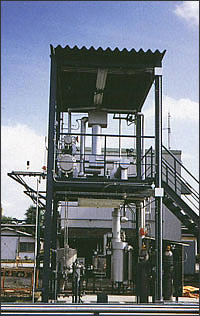
Membrane separation type solvent dehydration system

Great attention is recently being paid to global environmental issues, and it is now conceivable that companies will need to treat used solvents themselves. In consideration of this kind of social issue, we have developed a “membrane separation type solvent dehydration system,” which uses a polyimide membrane with superior dehydration properties developed by Ube Industries, Ltd. in combination with our own distillation and concentration technology that has resulted in solvents being more easily recovered.

THREE:[45]Reproduced by Andr & Sleigh, Ld., Bushey, Herts.
  • 1Under the distillation system, even in case of azeotropic solvent compositions, this system which remove water vapor by the polyimide membrane will easily dehydrate.
  • 2In comparison with the distillation system, it significantly saves on use of steam.
  • 3Dehydration can be performed through merely supplying evaporated vapor to the membrane module and maintaining the differential pressure between the permeable side and the impermeable side.
  • 4Solvent purity of 99.9% or more can be achieved by carrying out dehydration with a polyimide membrane only.
  • 5The polyimide membrane has superior heat and solvent resistance. Therefore, the vapor permeation system reduces contamination of the membrane and thus extends its life.
THREE:But the most remarkable growth of religion was through the instrumentality of the Wesleyan Methodists. These spread over all the country, through town and village, into places where the ministers of the Establishment had fallen into a spiritual sleep from want of rivalry. In Wales they found a great and almost unoccupied field. In Cornwall, where Wesley had been abused and pelted with stones, they became universal, and still continue to astonish the visitor to that county by their extraordinary numbers, almost every Cornish miner being of that sect. Throughout England the spread of Methodism has been a most influential cause of the revival of activity and discipline in the Established Church itself; for it soon became evident that the Church must exert itself, or the body of the people, especially in the country and in manufacturing districts, would be absorbed by the Wesleyan interest.

The aromatic polyimide membrane is highly permeable to water vapor but less permeable to vapors of organic compounds such as alcohol etc.

THREE:No sooner was the sentence passed than his judges were seized with a vehement desire to procure a pardon for the admiral. They made the most urgent entreaties to the Admiralty for that purpose, and Captain Augustus Keppel authorised Horace Walpole to say that he and four others of the members of the Council had something of importance to communicate, and desired to be relieved from their oath of secresy. The House of Commons was quite ready to pass a Bill for the purpose, and the king respited the admiral till all such inquiries had been made. But when the Bill had been passed by one hundred and fifty-three to twenty-three, it turned out that these five officers had nothing of consequence to disclose. Still Lord Temple, who was at the head of the Admiralty, was greatly averse from the carrying out of the sentence, which, in fact, was much disproportioned to the crime. Pitt also interceded with the king, and renewed applications were made to the Admiralty; but, on the other hand, the people were smarting under the loss of Minorca, and demanded the execution of the sentence. Hand-bills were posted up, "Hang Byng, or take care of the King." The House of Lords, when the Commons' Bill was carried up to them, however, settled the matter. Murray and Lord Hardwicke demanded of every member of the court-martial at the bar of the House whether they knew of any matter which showed their sentence to be unjust, or to have been influenced by any undue motive; and as all declared they did not, the Lords dismissed the Bill. The[126] sentence was therefore fixed for execution on the 14th of March. Byng, both during the trial, and now when brought on board the Monarch in Portsmouth Harbour to be shot, showed no symptoms of fear. When one of his friends, to prevent a man from coming in to measure Byng for his coffin, said, standing up by him, "Which of us is the taller?" Byng immediately replied, "Why this ceremony? I know what it means; let the man measure me for a coffin." On the deck he wished to have his eyes left unbound; but when told it might frighten the soldiers and distract their aim, he said, "Let it be done, then; if it would not frighten them, they would not frighten me." He fell dead at the discharge (March 14, 1757).
  • 1 Recovery of the detergent solvent Recovery of the cleaning solvent such as electronic parts industry, precision instrument industry.
  • 2Solvent recovery and the refinement Solvent recovery and the refinement such as chemical industry, an industry of medical supplies, food industry, the fermentation industry.
THREE:The excitement among the public, as this resolution became known, was intense, and large crowds assembled in front of the baronet's house, applauding, and shouting "Burdett for ever!" In their enthusiasm they compelled all passengers to take off their hats, and shout too. But they did not stop here. On such occasions a rabble of the lowest kind unites itself to the real Reformersand the mob began to insult persons of opposite principles and to break the windows of their houses. The Earl of Westmoreland, Lord Privy Seal, was recognised, and, as well as others of the same political faith, pelted with mud. The windows of Mr. Yorke, as the originator of the acts of the Commons, were quickly broken, and, in rapid succession, those of Lord Chatham, amid loud shouts of "Walcheren!" of Sir Robert Peel, the Duke of Montrose, Lord Castlereagh, Lord Westmoreland, Lord Wellesley, Mr. Wellesley Pole, Sir John Anstruther, and others. The Horse Guards were called out, and dispersed the rioters. The next day the serjeant-at-arms made his way into Sir Francis Burdett's house, and presented the Speaker's warrant for his arrest; but Sir Francis put the warrant in his pocket without looking at it, and a Mr. O'Connor, who was present, led the serjeant-at-arms down stairs, and closed the door on him. A troop of Life Guards and a company of Foot Guards were then ordered to post themselves in front of Sir Francis's house, and at night it was found necessary to read the Riot Act, and then the Guards were ordered to clear the street, which they did. Whilst this was doing, Sir Francis watched the proceeding from the windows, and was repeatedly cheered by the mob. Whilst thus besieged, he was visited by Lord Cochrane, the Earl of Thanet, Whitbread, Coke of Norfolk, Lord Folkestone, Colonel Wardle, Major Cartwright, and other Radical Reformers. Some of these gentlemen thought enough had been done to establish a case for a trial of the right of the House of Commons, and advised Sir Francis to yield to the Speaker's warrant. But Sir Francis addressed a letter to the sheriffs of London, informing them that an attack was made upon his liberty, by an instrument which he held to be decidedly illegal, and calling upon them to protect both him and the other inhabitants of the bailiwick from such violence. In this dilemma, the Premier, Mr. Perceval, advised that the serjeant-at-arms should lay the case before the Attorney-General, Sir Vicary Gibbs, which he did; but the reply of Sir Vicary only created more embarrassment, for he was doubtful whether, should any person be killed in enforcing the Speaker's warrant, it would not be held to be murder, and whether if the serjeant-at-arms were killed, a charge of murder would not issue against the perpetrator. The sheriffs, who were themselves strong Reformers, laid the letter of Sir Francis before the Speaker and before Mr. Ryder, the new Home Secretary, who counselled them to give their aid in enforcing the warrant. But these gentlemen proceeded to the house of Sir Francis Burdett, and passed the night with him for his protection.CHAPTER XVIII. The Reign of Victoria (continued).

Acetone, ethanol, methyl ethyl ketone, butanol, isopropyl alcohol, ethyl acetate, methyl isobutyl ketone, others (including hexane and toluene).